
Author: KACO Digital

  • Before You Spend Money on That Business Idea: 7 Questions That Could Save You From an Expensive Mistake

    KACO KINGDOM ENTREPRENEURSHIP

    The business idea looked promising. A new entrepreneur spent money on a logo, packaging, subscriptions and stock. Friends said it was brilliant. But when launch day arrived, almost nobody bought. The missing ingredient was not passion. It was evidence that real customers needed the offer.

    If you are considering a business, this article gives you a way to test it before risking your savings. You will answer seven questions, complete a 15-minute worksheet, and use a ready-to-copy AI prompt to plan a small, responsible experiment. You do not need to be a business expert to start.

    The Kingdom Foundation: Count the Cost

    Jesus used the picture of a builder who first sits down to estimate the cost of a tower (Luke 14:28). Proverbs 21:5 also connects diligent planning with a better outcome. These passages are not guarantees of business profit. They remind us that faith and careful preparation can belong together.

    Today’s principle: Faith gives you courage to begin. Wisdom teaches you what to examine before you invest.

    1. What exact problem will your business solve?

    A product is not a problem. ‘I want to sell journals’ describes what you want to make. ‘Busy parents struggle to organise school schedules and household tasks’ describes a problem someone might pay to solve.

    TAKE ACTION

    Write: ‘I help [specific person] solve [specific problem] so they can [desired result].’

    Example: Example: ‘I help self-employed cleaners send professional quotes quickly so they can respond to enquiries without spending an hour on paperwork.’

    2. Who is most likely to pay for the solution?

    ‘Everyone’ is too broad for a first offer. Choose one group with a clear need, a way to reach them, and the ability and willingness to pay.

    TAKE ACTION

    Describe one customer: their situation, urgent frustration, current workaround and where you can speak to them.

    Example: Example: ‘Independent cleaners who receive enquiries through WhatsApp and currently type every quote from scratch.’

    3. Are people already paying for similar solutions?

    Competition can be evidence of a market, but it does not prove customers will choose you. Look for real alternatives: paid products, services, DIY methods and free tools.

    TAKE ACTION

    Find three alternatives. Record their price, main promise, strengths, complaints and what is still missing. Do not copy their branding or proprietary content.

    Example: Example: Compare a quoting app, a spreadsheet template and a manual quote-writing service.

    4. What makes your solution worth choosing?

    Being ‘better’ is vague. Buyers need a concrete reason: simpler setup, clearer instructions, a specific audience, useful support or a distinct outcome.

    TAKE ACTION

    Finish this sentence: ‘Unlike [alternative], my solution helps [customer] achieve [result] through [credible difference].’

    Example: Example: ‘A mobile-friendly quote template built specifically for independent cleaners, with a checklist for each type of job.’

    5. Can you test demand before spending heavily?

    A like, compliment or AI-generated market report is not a purchase. Stronger signals include real enquiries, paid pilot bookings, deposits with transparent terms, and completed sales.

    TAKE ACTION

    Offer a small pilot to five to ten suitable potential customers. Ask what they currently do, what the problem costs them and whether they would try your solution. Do not pressure anyone.

    Example: Example: Show a working sample to five cleaners and ask whether they would use it for their next enquiry.

    6. What will it cost to deliver, and when might you break even?

    Revenue is not profit. Count materials, transaction fees, software, fulfilment, support, refunds, marketing and your time. Keep personal essentials and emergency money separate from speculative business spending.

    TAKE ACTION

    Calculate: price per sale minus variable cost per sale = contribution per sale. Fixed startup costs divided by contribution per sale = approximate sales needed to recover fixed costs.

    Example: Example: If you sell for ยฃ20, spend ยฃ5 per sale, and have ยฃ150 in fixed startup costs, you need about 10 sales to cover those fixed costs before taxes and other omitted expenses.

    7. Is this a business you can build with integrity and purpose?

    Kingdom entrepreneurship is more than adding a Bible verse to a sales page. It means making honest promises, treating customers fairly, keeping your commitments and creating genuine value.

    TAKE ACTION

    Ask: ‘Can I explain what this product actually does without exaggerating? Can I deliver what I promise? Does this help people rather than exploit their fears?’

    Example: Example: Say ‘helps organise your quotes’ rather than ‘guarantees you will double your income.’

    Your 15-Minute Business Idea Test: Complete This Worksheet

    Set a 15-minute timer. Write short, honest answers. If you cannot answer a question yet, write ‘I need to investigate’ rather than inventing certainty.

    My Business Idea Worksheet

    1. What specific problem will your business solve?

    2. Who is most likely to pay for the solution?

    3. Name three existing alternatives customers use.

    4. Why might someone choose your solution?

    5. How will you test demand before investing heavily?

    6. What is your estimated starting cost?

    7. What one action will you take in the next 24 hours?

    Save this page, print it, or copy the questions into your notes. Use the answers to decide what evidence you still need.

    A Ready-to-Copy AI Prompt for Your Business Idea

    Once you have completed the worksheet, paste the following prompt into ChatGPT or another AI assistant. Replace the bracketed sections with your real answers. Treat the output as hypotheses to test, not proof of demand.

    COPY THIS PROMPT

    Act as a careful small-business validation coach, not a hype-driven salesperson. My idea is: [IDEA]. The specific problem is: [PROBLEM]. My target customer is: [CUSTOMER]. Three alternatives are: [ALTERNATIVES]. My proposed difference is: [DIFFERENCE]. My estimated starting budget is: [BUDGET]. My available time is: [HOURS PER WEEK]. Ask up to five essential clarifying questions first. Then identify five key assumptions, three likely weaknesses, realistic competitor-research questions I can verify independently, and a low-cost seven-day validation plan. Include five neutral customer-interview questions that do not lead people toward saying yes; a simple pilot offer; clear stop/go criteria; an honest starter budget with costs I might have missed; and a one-page action checklist. Separate verified facts from assumptions. Do not invent market statistics, customer demand, competitor prices or guaranteed income. Suggest responsible ways to test the idea without risking money needed for essentials.

    On mobile, press and hold the text to select and copy it into your AI assistant.

    Your Seven-Day Validation Plan

    NEXT STEP: TURN YOUR RESEARCH INTO A PLAN

    Build Your Business Plan With Business in a Box

    Once you have tested your idea with real people, the Business in a Box Master Prompt Systemโ„ข can help you organise your next steps, develop your offer and work through a structured AI-assisted business-building process. It is a planning and creation tool, not proof that an idea will sell. Keep using real customer feedback to guide your decisions.

    EXPLORE BUSINESS IN A BOX MASTER PROMPT SYSTEM โ†’

    ALSO FOR YOUR FAITH JOURNEY

    Receive Your Free Faith & Courage Gift

    As you build with wisdom, strengthen your faith each day. Get our FREE 7-Day Faith & Courage Devotional + Prayer Generator App, with Scripture, prayer and practical action steps.

    GET MY FREE DEVOTIONAL & PRAYER GENERATOR APP โ†’

    1. Day 1: Define the problem and target customer.
    2. Day 2: Research three alternatives and their limitations.
    3. Day 3: Interview two potential customers without pitching.
    4. Day 4: Interview three more and look for repeated patterns.
    5. Day 5: Create a sample, demonstration or small pilot offer.
    6. Day 6: Invite suitable customers to try the pilot, and record actual interest.
    7. Day 7: Review feedback, costs and evidence. Decide to proceed, improve or stop.

    Kingdom Reflection

    Not every good idea is the right idea for this season. You can honour God by working diligently, listening carefully, managing resources wisely and refusing to promise what you cannot deliver.

    Remember: A decision not to invest yet can be an act of wisdom, not a lack of faith.

    A Prayer for Wisdom in Business

    Heavenly Father, thank You for the gifts, ideas and opportunities You have placed before me. Give me wisdom to distinguish excitement from evidence, patience to plan carefully, and integrity in every promise I make. Help me serve people with genuine value and protect the resources entrusted to me. Guide my next step, whether that means beginning, improving or waiting. In Jesus’ name, Amen.

    Grow in Faith While You Build

    Strong businesses need practical planning, and strong hearts need daily encouragement. Receive our FREE 7-Day Faith & Courage Devotional + Prayer Generator App, with Scripture, reflection, prayer and simple daily action steps.

    GET MY FREE DEVOTIONAL & PRAYER GENERATOR APP โ†’

    KACO FAMILY: Loving God โ€ข Serving People โ€ข Changing Lives.

    Nothing Broken. Nothing Missing. Nothing Lacking.
    Be blessed, be the best.

  • How to Overcome Financial Anxiety and Stress Daily: 7 Faith-Based Steps

    At 2:17 a.m., Daniel opened his banking app for the third time. The balance had not changed. The rent was still due. His daughter’s school payment was still waiting. Yet he kept refreshing the screen, as though one more look might produce an answer.

    Then his wife whispered from beside him, โ€œAre you checking the money again?โ€

    He turned the phone face down. โ€œI’m just trying to make sure we’re okay.โ€

    She took his hand. โ€œBut you’ve been trying to make sure all night.โ€

    Financial anxiety can feel like that: your body is at home, but your mind is already fighting tomorrow’s bills. You may be working hard, praying faithfully, and still feeling afraid. That does not make you a bad Christian. It means you are carrying a real concern that needs both spiritual encouragement and practical attention.

    1. Name the fear instead of letting it name your future

    Financial stress often speaks in sweeping sentences: โ€œI’ll never catch up.โ€ โ€œEverything will fall apart.โ€ โ€œI’m failing my family.โ€ But a frightening thought is not the same as a confirmed fact.

    Take a sheet of paper and complete two sentences: โ€œWhat I am afraid of isโ€ฆโ€ and โ€œWhat I actually know today isโ€ฆโ€ You may discover that the bill is real, but the worst-case ending is still a prediction. Naming the difference makes room for a wiser next step.

    2. Give tomorrow back to God, and give today your attention

    In Matthew 6:25โ€“34, Jesus speaks directly about worries over food, clothing, and daily needs. He does not pretend that those needs are imaginary. Instead, he reminds his listeners of their value to their heavenly Father and calls them to attend to the day before them.

    Kingdom reflection: Faith does not require you to know how every bill will be paid six months from now. It invites you to act faithfully with the information and opportunities you have today. Read Matthew 6:25โ€“34.

    3. Replace a money spiral with a ten-minute money check-in

    Constantly checking your balance can increase distress without changing your circumstances. Choose one short time each day to review your finances calmly.

    • Write down the money available right now.
    • List essential payments due in the next seven days: housing, food, utilities, transport, and necessary care.
    • Identify one payment or expense that can be reduced, delayed, or discussed with the provider.
    • Choose one action for today, such as requesting a payment plan or updating your budget.

    A budget is not a verdict on your worth. It is a map of your current position. If you cannot cover essentials, reach out early to creditors or a reputable free debt-advice service rather than waiting for a crisis.

    4. Pray specifically, then take one practical step

    Philippians 4:6โ€“7 teaches believers to bring their concerns to God through prayer and thanksgiving. Prayer can steady your heart, but it does not mean ignoring letters, avoiding conversations, or waiting passively for money to appear.

    Try a simple rhythm: Pray. Write. Act. Pray about the exact need. Write the next sensible action. Then take it, even if the step is small.

    Perhaps today’s step is applying for suitable work, calling a lender, cancelling an unused subscription, speaking honestly with your spouse, or asking a trusted person to help you review the numbers. Small, repeated actions restore a sense of direction.

    5. Stop measuring your value by your bank balance

    Money can pay for necessities, but it cannot measure your character, your love for your family, or your value before God. A difficult season is not your identity.

    When shame says, โ€œYou are behind, so you are less,โ€ answer it with truth: โ€œI am facing a challenge. I can seek wisdom, receive help, and make the next responsible choice.โ€

    6. Build a daily peace routine

    Before opening your financial apps in the morning, try this five-minute practice:

    1. One minute of stillness: breathe slowly and notice how you feel.
    2. One Scripture: read a short passage such as Matthew 6:34 or Philippians 4:6โ€“7.
    3. One honest prayer: tell God what is worrying you.
    4. One money action: write the most useful financial task for today.
    5. One act of gratitude: notice something good that money cannot buy.

    If anxiety is regularly affecting your sleep, work, relationships, or health, consider talking with a qualified mental-health professional as well as someone you trust. Seeking support is not a failure of faith.

    7. Remember that you do not have to carry this alone

    Daniel’s bank balance did not change that night. But something else did. He finally told his wife the full truth about what frightened him. Together, they wrote down their bills, made two calls the next morning, and agreed to stop discussing money after bedtime unless something urgent happened.

    They did not solve every financial problem overnight. They stopped facing the problems separately.

    Sometimes the first answer to financial anxiety is not more money in your hand. It is less fear carried alone.

    A prayer for financial peace

    Heavenly Father, You know every bill, every responsibility, and every worry I have not spoken aloud. Give me peace without denial, wisdom without panic, and courage to take the next right step. Open my eyes to honest opportunities, trustworthy support, and habits that strengthen my household. Remind me that my worth is not determined by my finances. Help me to trust You today while acting responsibly with what I have. In Jesus’ name, Amen.

    Free faith encouragement for your daily journey

    If you would like a simple daily faith routine, KACO has a FREE 7-Day Faith & Courage Devotional + Prayer Generator App to encourage you through Scripture, reflection, prayer, and practical action.

    GET MY FREE DEVOTIONAL & PRAYER GENERATOR APP โ†’

    At KACO FAMILY, our vision is Loving God โ€ข Serving People โ€ข Changing Lives. We believe that even in difficult seasons, we can grow in faith, support one another, and take meaningful steps forward.

    Nothing Broken. Nothing Missing. Nothing Lacking.
    Be blessed, be the best.
  • Make Room for God: A Simple Way to Begin a Daily Faith Routine

    Your phone buzzes before your eyes are fully open. A message from last night is still waiting for a reply, a meeting sits at the top of your calendar, and the day has already started moving before you have said a single word to God.

    If that sounds familiar, you are in good company. Most of us do not lack the desire to grow in faith. We lack a realistic way to practise it inside a life that is already full.

    Where Most Devotional Habits Break

    It is easy to believe that a real devotional life needs an hour, a perfect setting and an uninterrupted morning. Most days will not offer that, and so the habit quietly dies before it has a chance to take root.

    Day One of our free 7-Day Faith & Courage Devotional starts in exactly this tension, because it is the one almost every believer gets stuck on first.

    What Jesus Modelled in His Busiest Season

    Mark tells us that Jesus, in the middle of a demanding season of healing crowds and travelling from town to town, chose to meet with His Father before the demands of the day could talk Him out of it.

    “Early in the morning, while it was still dark, he rose up and went out, and departed into a deserted place, and prayed there.” Mark 1:35 (WEB)

    He did not wait for an empty schedule. There was no empty schedule coming. The disciples went looking for Him because people needed Him, and yet He had already chosen the quiet place first.

    The Size of the Space Matters Less Than the Decision to Use It

    Five minutes before the house wakes. A few quiet minutes on a train. A pause before you check your phone. Jesus shows us that the size of the window matters far less than the decision to use it.

    And if you have tried and failed to build a habit like this before, that is not a disqualification. It is simply where most people start. A missed morning does not undo the mornings you choose from here.

    Kingdom truth to carry: A small, honest beginning with God outlasts a perfect plan that never starts.

    Try This Today

    • Pick one realistic time and one physical spot for the next seven days, and write both down.
    • Read one short verse slowly, aloud if you can, before you check anything else.
    • Speak to God honestly about the day ahead, in your own words, for a few minutes.

    You are not trying to impress God with discipline. You are making room for Him in a life that is genuinely full. That room does not have to be large. It only has to be real, and it only has to start today.

    Get the Full 7 Days, Free

    This is just Day One. The full 7-Day Faith & Courage Devotional walks you through a complete, repeatable rhythm, courage in the middle of fear, turning worry into prayer, faithfulness in small things, and more, alongside a free Prayer Generator App to guide your own prayer time.

    Get Your Free 7-Day Faith & Courage Devotional + Prayer App →

    Delivered straight to your inbox, for you and your family.


    KACO Kingdom
    Nothing Broken. Nothing Missing. Nothing Lacking.
    Be blessed, be the best.

  • The Wisdom of Solomon on Wealth

    Few men in history have been given more wealth, more wisdom or more opportunity to enjoy both than King Solomon. Gold flowed into Jerusalem by the ton. His fleet brought back treasure from distant lands. His table was set with vessels of gold, not silver, because silver “was accounted nothing of” in his day (1 Kings 10:21).

    And yet the same man who possessed all of it left us the most searching words on wealth in all of Scripture. Not because he lacked money, but because he had all of it and still went looking for what money could not buy.

    If you want to know what wealth can really do for a person, and what it can never do, Solomon is the one man qualified to tell you. He tried it all.

    1. Wealth Is a Gift, Not a Guarantee

    Solomon never treated his riches as something he was owed. He understood them as something given.

    “I will give you what you have not asked for, both wealth and honor.” 1 Kings 3:13

    Notice the order. Solomon asked for wisdom. Wealth was added, unrequested, as a by-product of a wise heart used well.

    That is a very different posture from chasing money directly and hoping wisdom shows up eventually. Solomon’s wealth was downstream of his wisdom, not a substitute for it.

    The lesson for us is not to despise ambition. It is to get the order right. Pursue the wisdom to serve people well, to steward what you’re given, to build something of real value, and let increase follow from that foundation, not the other way around.

    2. Diligence, Not Luck, Produces It

    Solomon had no patience for the idea that wealth simply falls on the fortunate.

    “Lazy hands make for poverty, but diligent hands bring wealth.” Proverbs 10:4

    “Dishonest money dwindles away, but whoever gathers money little by little makes it grow.” Proverbs 13:11

    Two ideas sit side by side here that our culture tends to separate: hard, consistent work, and patient, honest accumulation. No shortcuts, no schemes, no windfalls to wait on.

    Solomon’s own kingdom wasn’t built by chance. It was administered, taxed, traded and managed by real people doing real work across twelve districts (1 Kings 4). Wealth, in his experience, was the fruit of structure and diligence, not a lottery ticket.

    3. It Cannot Buy Contentment

    This is where Solomon’s testimony becomes uncomfortable, because he had already won at the game most of us are still playing.

    In Ecclesiastes, written from the far side of having everything, he tells us plainly what he found:

    “Whoever loves money never has enough; whoever loves wealth is never satisfied with their income. This too is meaningless.” Ecclesiastes 5:10

    He denied himself nothing. Houses, vineyards, gardens, singers, silver, gold, “the delights of the heart of man” (Ecclesiastes 2:8-10). And his verdict on all of it was that it satisfied for a moment and then demanded more.

    This is not a case against building wealth. It is a warning against expecting wealth to do a job it was never designed to do. Money can fund a life. It cannot furnish a soul.

    4. A Good Name Outlasts a Full Bank Account

    Solomon ranked character above capital, plainly and repeatedly.

    “A good name is more desirable than great riches; to be esteemed is better than silver or gold.” Proverbs 22:1

    Riches can be lost overnight. A reputation for integrity, once earned, tends to keep working for you long after the money that built it is gone, and it keeps opening doors money alone never could.

    If you ever have to choose between a profitable shortcut and your integrity, Solomon’s ledger says the name is worth more than the deal.

    5. Wealth Without Wisdom Is a Liability

    Solomon watched money amplify whatever character was already present in the person holding it, for better or worse.

    “The wealth of the rich is their fortified city; they imagine it a wall too high to scale.” Proverbs 18:11

    The trap Solomon names here is subtle. It isn’t the money itself. It’s the false sense of security money creates, a walled city that feels safer than it actually is.

    Wealth in wise hands builds, provides and protects. Wealth in unwise hands buys a taller wall and a false sense of safety behind it. The money doesn’t change. The steward does.

    6. Generosity Is Part of the Design, Not an Afterthought

    Solomon treated giving as functional wisdom, not sentimental charity.

    “Honor the Lord with your wealth, with the firstfruits of all your crops; then your barns will be filled to overflowing.” Proverbs 3:9-10

    “One person gives freely, yet gains even more; another withholds unduly, but comes to poverty.” Proverbs 11:24

    Firstfruits, not leftovers. Solomon put honoring God ahead of the spreadsheet, and named generosity as one of the very mechanisms wealth was meant to flow through, not around.

    7. The One Thing Solomon Said Was Better Than Gold

    After everything, silver, gold, vineyards, singers, servants, a fleet of trading ships, Solomon still pointed somewhere else entirely for the thing of true worth.

    “How much better to get wisdom than gold, to get insight rather than silver!” Proverbs 16:16

    The man with more gold than any king of his era, comparing gold unfavorably to wisdom, is not a throwaway line. It’s a verdict, delivered by the one person history has ever produced who was in a position to actually compare the two.

    A Wealth Audit, Solomon’s Way

    Take a moment and answer these honestly:

    • Order: Am I chasing wisdom and letting increase follow, or chasing increase and hoping wisdom catches up?
    • Diligence: Is what I’m building the fruit of consistent, honest work, or am I looking for a shortcut?
    • Contentment: If my income never grew again from today, would I still be at peace?
    • Character: Would I trade my name for a profitable shortcut right now, if no one would ever know?
    • Stewardship: Does my money make me more secure in God, or more secure in my bank balance?
    • Generosity: Am I giving from the firstfruits, or only from whatever happens to be left over?

    Pick the one answer that stung the most. That’s the one worth acting on this week.

    A Prayer on Wealth and Wisdom

    Father, thank You for every resource You have placed in my hands. Teach me to want wisdom more than I want increase, and to trust that when I seek You first, what I actually need will follow. Guard me from the love of money, and from the false security that a full account can create. Make me diligent rather than idle, and generous rather than withholding. Let my wealth, however much or little it is, always point back to You rather than compete with You. In Jesus’ name, Amen.

    The KACO Takeaway

    Solomon is the one voice in Scripture with the standing to tell us the truth about money, because he had all of it to test.

    His verdict wasn’t that wealth is evil. It was that wealth is a tool, downstream of wisdom, built through diligence, incapable of buying contentment, worthless without character, and always meant to move through generous hands rather than pile up in closed ones.

    Build. Work diligently. Steward well. Give generously.

    But hold it all the way Solomon eventually wished he had held it from the start: with an open hand, and wisdom held tighter than the gold.


    KACO AI Tools
    Learn. Build. Earn. Serve.
    Nothing Broken. Nothing Missing. Lacking Nothing.

  • How to Build Your First AI App Without Coding Experience

    How to Build Your First AI App Without Coding Experience

    For years, building an app sounded like something reserved for programmers, technology companies and people with large development budgets. That picture is changing quickly.

    Today, ordinary business owners, creators, educators and professionals can use artificial intelligence to turn a useful idea into a working digital tool. You do not need to begin with complicated code. You begin with a real problem, a clear outcome and a conversation.

    Start with the problem, not the technology

    A common beginner mistake is trying to invent something enormous. Your first app does not need to compete with a global platform. It only needs to make one repeated task easier.

    Look at the work you already do. Is there a calculation you repeat every week? A decision you make using the same questions? Information you regularly organise? A process that customers find confusing?

    These small frustrations are often strong app ideas because they already have a purpose. A useful first project could help someone compare options, estimate a cost, organise a plan, track a simple goal or prepare for a conversation.

    Your real role is to provide direction

    AI can produce the technical parts, but it still needs clear leadership. Think of yourself as the director of the project. You explain who the app is for, what information it should accept, what result it should provide and how the experience should feel.

    You then review what the AI creates and give simple feedback:

    • โ€œMake the instructions easier to understand.โ€
    • โ€œAdd a reset button.โ€
    • โ€œMake this work properly on a mobile phone.โ€
    • โ€œExplain the result in plain English.โ€
    • โ€œCheck every button and calculation, then repair anything that is not working.โ€

    This is why clarity matters more than technical language. When your first instruction is vague, the result will usually be vague. When the instruction explains the user, purpose, inputs, results and important boundaries, the AI has a much stronger foundation.

    One valuable prompt you can try today

    Copy the prompt below into an AI assistant. It creates a small decision-making tool that you can test and improve through conversation.

    Act as an experienced app builder who explains everything in plain English. Build a simple, attractive, mobile-friendly app called โ€œSmart Choice Helper.โ€ The user should be able to enter up to three options they are considering. For each option, let them give a score from 1 to 10 for value, affordability, ease and urgency. Calculate the total score, clearly show which option ranks highest and explain that the result is a guide rather than a final decision. Add a reset button and helpful instructions. Create it as one self-contained HTML file that can work offline in a browser. Before giving me the finished file, test every input, button and calculation for errors. Do not require a login, database or paid service.

    After the AI creates it, do not worry if the first version is not perfect. Open it, click every button and try unusual entries. Then describe what happened in everyday language and ask the AI to correct it.

    Building is only the beginning

    A working screen is not automatically a useful app. Good app creation also involves testing, improving instructions, checking calculations, making the design easy to use and protecting the user from confusing results.

    If an app handles sensitive information, payments, medical matters, legal decisions or important financial choices, professional review and stronger security may also be necessary. Start with a low-risk project while you learn how to direct, test and improve AI-generated work responsibly.

    Your first small app can change how you see AI

    The biggest breakthrough often comes when you move from asking AI for information to using it to create something that works. Even a small tool can save time, improve a process or help another person make a clearer decision.

    You do not need to know everything before you begin. Choose one manageable problem, describe the result clearly and improve the project one conversation at a time.

    Ready to build your first AI app?

    KACO Vibe Coding Workflow Made Simple is a practical beginner course designed for people with no coding experience. It guides you from idea to a working AI-assisted app using clear language, practical exercises, knowledge checks and a project workbook.

    Explore the KACO Vibe Coding Course

    One-time payment: $57. No upsells.

    Small ideas can become useful tools. The important thing is to start.

  • How to Create a Digital Product People Will Actually Pay For

    How to Create a Digital Product People Will Actually Pay For

    Creating a digital product has never been easier. With modern AI tools, design platforms and online marketplaces, almost anyone can create an ebook, template, course, prompt system, planner or software tool.

    But easy creation does not guarantee sales.

    Many digital products fail because their creators begin with the product instead of the problem. They spend days designing something attractive without first confirming that anyone genuinely needs it.

    A successful digital product begins with a simple question:

    What problem can I help a specific group of people solve?

    What Is a Digital Product?

    A digital product is something customers can purchase, download or access electronically.

    Examples include:

    • Ebooks and practical guides
    • Online courses and workshops
    • Templates and worksheets
    • Prompt packs and prompt systems
    • Digital planners and journals
    • Membership resources
    • Printable materials
    • Checklists and workbooks
    • Offline HTML applications
    • AI-powered tools
    • Business systems and automation kits

    Unlike physical products, digital products do not require traditional manufacturing, packaging or shipping. Once created, the same product can usually be delivered to many customers automatically.

    However, the strongest advantage is not simply that digital products are inexpensive to distribute. It is that they can package knowledge, experience and practical solutions into something people can use repeatedly.

    Step 1: Start With a Real Problem

    Do not begin by asking, โ€œWhat can I create?โ€

    Begin by asking:

    • What are people struggling with?
    • What task takes them too much time?
    • What result do they want but do not know how to achieve?
    • What mistakes are they repeatedly making?
    • What information is currently confusing them?
    • What process could be made easier?

    The clearer the problem, the easier it becomes to create and market the solution.

    For example, โ€œa business ebookโ€ is too broad.

    โ€œA step-by-step guide that helps first-time entrepreneurs validate and launch their first digital productโ€ is much clearer. It identifies the audience, the problem and the desired outcome.

    Step 2: Choose a Specific Audience

    A product designed for everybody often feels relevant to nobody.

    Instead of creating a general social-media planner, you could create:

    • A content planner for Christian authors
    • A social-media system for local service businesses
    • A posting calendar for new coaches
    • A promotion planner for digital-product sellers

    Specific products are easier to explain because prospective customers can immediately recognise that the product was made for them.

    Your audience should be able to read the title and say:

    โ€œThis is exactly what I need.โ€

    Step 3: Validate the Demand

    Before investing significant time in creation, look for evidence that people already want a solution.

    You can study:

    • Marketplace search results
    • Customer reviews
    • Questions asked in Facebook groups and online communities
    • YouTube comments
    • Search-engine suggestions
    • Competitorsโ€™ frequently asked questions
    • Popular books, courses and templates
    • Complaints about existing products

    The objective is not to copy another creator. It is to understand what customers already buy, what they appreciate and what they still find disappointing.

    Look for recurring complaints such as:

    • โ€œThis was too complicated.โ€
    • โ€œI needed more examples.โ€
    • โ€œIt explained the idea but not how to implement it.โ€
    • โ€œI wish it included a template.โ€
    • โ€œThis was written for advanced users.โ€

    Those complaints reveal opportunities to create something more practical, complete or accessible.

    Step 4: Define One Clear Outcome

    Every useful digital product should help the customer achieve a recognisable result.

    Do not simply promise information. Promise a practical transformation.

    A course should help learners develop a skill.

    A template should help users complete a task faster.

    A planner should help them organise or track something important.

    A business tool should help them make a decision, follow a process or produce an output.

    Write this sentence before building your product:

    After using this product, the customer will be able to __________.

    If you cannot complete that sentence clearly, the product probably needs a sharper focus.

    Step 5: Choose the Right Format

    The best format depends on the problem being solved.

    Use an ebook when the customer needs explanation, guidance or a structured roadmap.

    Use a workbook when reflection, planning or written exercises are essential.

    Use templates when the customer needs to complete something quickly.

    Use a course when the customer needs demonstrations, guided lessons and progressive learning.

    Use an application or interactive tool when the customer needs personalised outputs, calculations, automation or repeated assistance.

    Sometimes the strongest offer combines several formats. A course could include a workbook, templates and a practical tool that helps learners implement what they have learned.

    Step 6: Build the Minimum Complete Solution

    Your first version does not need every possible feature. It needs everything necessary to deliver the promised result.

    There is an important difference between a minimum product and an incomplete product.

    A minimum complete product:

    • Solves the main problem
    • Provides clear instructions
    • Includes the essential resources
    • Is easy to navigate
    • Produces the promised outcome

    Additional features can be introduced after receiving real customer feedback.

    Step 7: Make It Easy to Use

    Customers do not measure value only by the amount of content. They also measure how easily they can understand and apply it.

    Improve the customer experience by including:

    • A quick-start guide
    • Clear section headings
    • Step-by-step instructions
    • Practical examples
    • Checklists
    • Templates
    • Action steps
    • Troubleshooting guidance
    • A clear explanation of what to do next

    A smaller product that creates action can be more valuable than a massive bundle that leaves the customer overwhelmed.

    Step 8: Package and Position the Product

    Presentation influences how customers understand value.

    Your product needs:

    • A clear name
    • A strong benefit-focused headline
    • An attractive cover or product mock-up
    • A description of the problem it solves
    • A clear explanation of who it is for
    • A list of what is included
    • An explanation of the expected outcome
    • A simple call to action

    Do not rely on exaggerated promises. Clearly demonstrate why the product is useful and what makes your approach different.

    Step 9: Test Before You Scale

    Invite a small number of people from your target audience to use the product.

    Ask them:

    • Was the product easy to understand?
    • Where did you become confused?
    • What did you find most valuable?
    • What was missing?
    • Could you achieve the promised result?
    • Would you recommend it to someone else?

    Use their feedback to strengthen the product before investing heavily in advertising.

    Turn Your Idea Into a Valuable Product

    Digital-product creation is not about producing more files. It is about transforming a useful idea into a practical solution that people can understand, use and benefit from.

    Start with a proven problem. Choose a specific audience. Define one clear outcome. Build the right solution and package it professionally.

    That is how an idea becomes more than information.

    It becomes a product with genuine value.

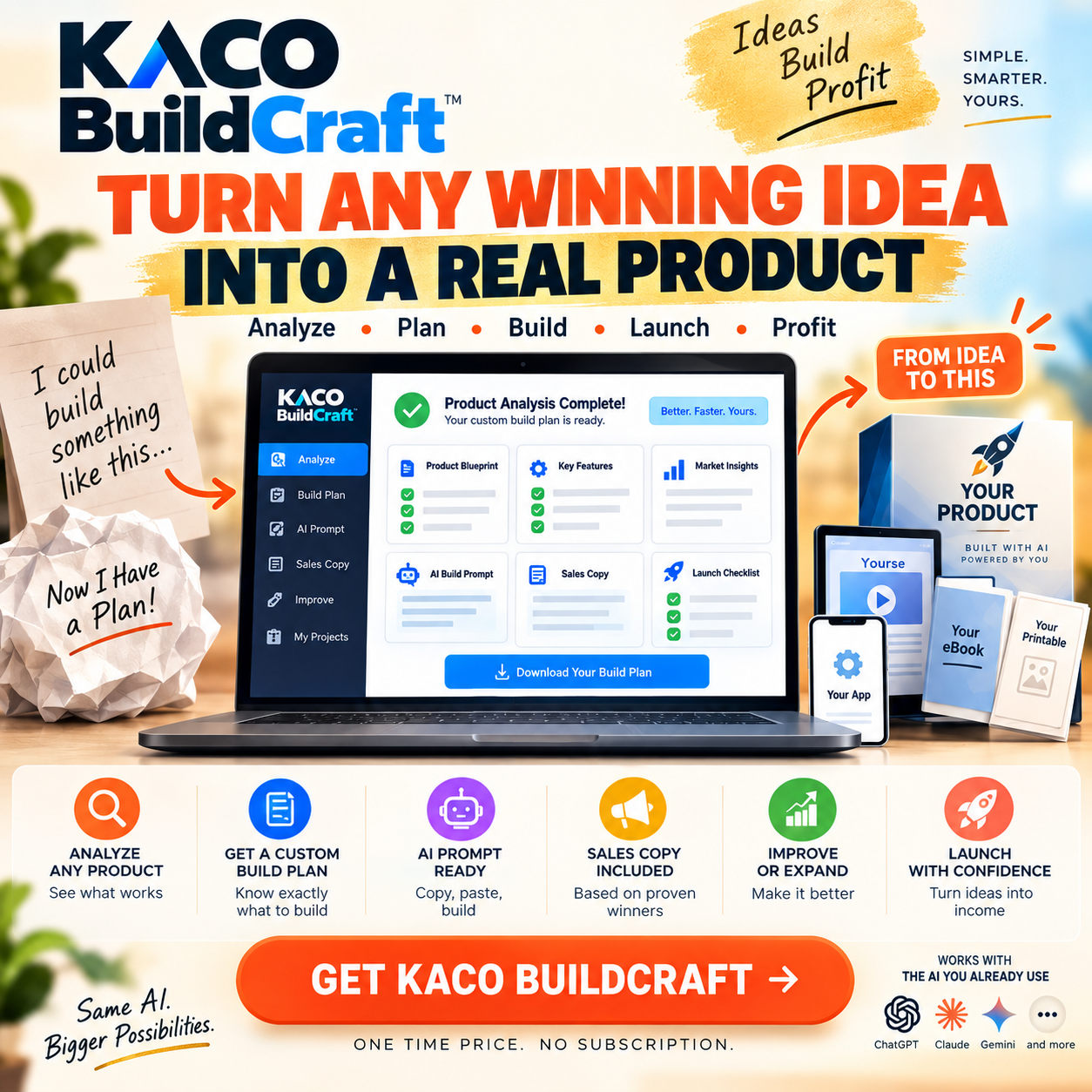
    KACO BuildCraft digital product creation system mock-up

    Coming next: KACO BuildCraftโ„ข will provide a guided system for turning a promising idea into a complete, market-ready digital product.

  • 10 Biblical Principles for Business, Productivity and Growth

    Biblical principles for business begin much earlier in Scripture than many people realise. In the opening chapter of Genesis, we see creation, productive work, order, evaluation, fruitfulness, multiplication, management and rest.

    The Bible begins with work.

    Not with money. Not with business. Not even with humanity.

    It begins with God creating.

    “In the beginning God created the heavens and the earth.” Genesis 1:1

    Before we meet Adam, Abraham, Moses or David, Scripture introduces us to God as Creator.

    He takes what is formless and gives it form. He brings order where there was disorder. He creates environments capable of sustaining life. He produces. He evaluates His work.

    Then He entrusts part of what He has created to humanity and gives mankind an extraordinary mandate:

    “Be fruitful and multiply; fill the earth and subdue it…” Genesis 1:28

    There is far more in these verses than a lesson about business. Genesis 1 is fundamentally revealing God, His creation and humanity’s place within it.

    But within that larger truth are principles that can profoundly shape the way Christians think about work, business, productivity, management and wealth creation.

    God creates. God produces. God brings order. God evaluates. God entrusts.

    And humanity is commanded to be fruitful, multiply and exercise responsible stewardship over what God has made.

    Perhaps Christian entrepreneurship should begin there.

    1. God Is a Creator: So Don’t Spend Your Life Only Consuming

    Genesis 1 repeatedly says, “God made…” “God created…” “Let there be…”

    Something that didn’t exist was brought into existence.

    Human creativity is obviously not identical to God’s creation, we don’t create from nothing as God does.

    But because human beings are made in God’s image, creativity, productive work and responsible cultivation have an important place in human life.

    And that raises a challenging question: what are you creating?

    Many of us spend enormous amounts of time consuming things other people created. We watch. Scroll. Listen. Buy. Read. Browse. Consume.

    There is nothing inherently wrong with consumption. But if God has given you abilities, knowledge, resources and opportunities, your life shouldn’t consist entirely of consuming what everybody else produces.

    Perhaps you can create a business, a book, a useful service, software, a course, a better process, a product, a solution, a job for somebody, or an educational resource. Something that makes another person’s life better.

    Consumers ask, “What can I get?” Creators also ask, “What can I contribute?”

    Business begins to look different when creation becomes an act of service.

    2. God Created Something Useful

    Look carefully at Genesis 1. God’s creation wasn’t random activity. There was purpose.

    Light served a purpose. Land served a purpose. Vegetation served a purpose. The heavenly lights served purposes. The environment prepared for living creatures served a purpose.

    Then humanity was placed within that environment.

    This gives entrepreneurs an important principle: don’t create merely because you can. Create something useful.

    The marketplace doesn’t reward effort simply because you worked hard. People generally pay for value.

    A customer isn’t primarily interested in how many hours you spent building your product. They’re asking: does this help me? Does it save time? Solve a problem? Teach something? Reduce frustration? Create enjoyment? Improve a result? Make something easier? Help me earn, save, understand, organise or accomplish something?

    That’s why one of the best questions a Christian entrepreneur can ask isn’t, “What can I sell?” It is, “What can I create that genuinely serves people?”

    Profit then becomes connected to value creation rather than exploitation.

    3. God Brought Order Before He Entrusted Management

    Genesis describes the earth as formless and empty. Then we see separation, organisation and order.

    Light and darkness. Waters and land. Vegetation. Living creatures. Humanity.

    There is sequence. There is structure. There is order.

    Businesses need the same principle. You cannot sustainably grow chaos.

    If your finances are disorganised, growth can magnify the problem. If customer information is scattered everywhere, more customers can create more confusion. If every task depends on the founder remembering what to do, growth eventually becomes exhausting.

    This is where management enters the picture. Good management asks: what needs to happen? Who is responsible? When should it happen? What resources are required? How do we know it was completed properly? What should happen next?

    Spirituality isn’t an excuse for disorder. Paul later wrote:

    “Let all things be done decently and in order.” 1 Corinthians 14:40

    That verse concerns order in Christian worship, not corporate management. But the broader biblical appreciation for responsible order should challenge us.

    If God increases what you’re building, are your systems ready to manage the increase?

    4. God Worked in Stages

    Genesis gives us another productivity lesson. Everything wasn’t presented as one undifferentiated activity. There was progression. One stage followed another.

    That matters because one reason people fail to execute big ideas is that they try to build the entire vision at once.

    Imagine saying, “I want to build an international company.” That’s a vision. It isn’t today’s task.

    Today’s task might be: research ten potential customers, build the first product prototype, create the landing page, call one supplier, write the first chapter, test the first advertisement, or make the first sale.

    Big visions are accomplished through smaller acts of faithful execution. You don’t have to finish everything today. You need to know what today’s work is.

    5. God Evaluated His Work

    Genesis repeatedly contains this statement: “And God saw that it was good.”

    Then after creation:

    “God saw all that he had made, and it was very good.” Genesis 1:31

    Again, we should be careful not to reduce Genesis to a business manual. But there is a useful pattern: work happened, then the result was evaluated.

    Entrepreneurs need this discipline. Don’t merely produce. Review.

    Did the advertisement work? Did customers like the product? Did the course actually help students? Did the new process save time? Was the investment worthwhile? Did sales increase? Were customers satisfied? What should we improve?

    Productivity isn’t measured by how busy you were. Productivity is measured by meaningful results.

    Sometimes the most productive business decision is stopping something that isn’t working.

    6. God Blessed Humanity to Be Fruitful

    Then comes the mandate:

    “God blessed them and said to them, ‘Be fruitful and increase in number; fill the earth and subdue it.’” Genesis 1:28

    In its immediate context, this includes humanity multiplying and filling the earth. We shouldn’t pretend the verse is simply saying, “Build a profitable company.” It isn’t.

    But the wider biblical picture of human vocation includes fruitfulness, cultivation, stewardship and productive responsibility.

    Fruitfulness should make Christians uncomfortable with permanently wasted potential.

    If God has entrusted you with ability, what are you doing with it? If He gave you knowledge, are you developing it? If you have an opportunity, are you stewarding it? If you have a business, is it producing value? If you have employees, are you helping them become productive? If you have money, is all of it being consumed, or is some being deployed productively?

    Fruitfulness means something should come from what God placed in your hands.

    7. Fruitfulness Comes Before Multiplication

    There is an interesting order in the command: be fruitful, then multiply.

    That’s worth thinking about in business.

    Many entrepreneurs want multiplication before fruitfulness. They want 100,000 customers before proving that ten customers genuinely value the product. They want five branches before making one location excellent. They want to advertise aggressively before establishing that the offer converts. They want a team before developing a repeatable process. They want scale before establishing value.

    But multiplying something broken simply produces more brokenness.

    Before scaling, ask: does this work? Does it solve the problem? Will customers return? Can we deliver consistently? Are the economics sustainable? Have we established a repeatable process?

    First produce good fruit. Then think about multiplying it.

    8. Multiplication Requires Management

    Suppose your business makes ยฃ1,000. Then it grows to ยฃ10,000. Then ยฃ100,000.

    Has the business simply received more money? No. It has received more responsibility.

    More customers may mean more complaints. More revenue creates more financial decisions. More employees require more leadership. More products require more systems. More influence creates greater accountability.

    This is why growth without management can become destructive.

    Jesus taught a principle of stewardship:

    “Whoever can be trusted with very little can also be trusted with much…” Luke 16:10

    If you’re asking God for more, also develop the capacity to manage more.

    Your prayer shouldn’t only be, “Lord, increase me.” It should also be, “Lord, increase my capacity to steward the increase.”

    9. “Subdue” Points Toward Responsible Stewardship, Not Exploitation

    Genesis also tells humanity to subdue the earth and exercise dominion. That has sometimes been misunderstood as permission for careless exploitation.

    But biblical dominion is exercised under God’s ultimate ownership. Psalm 24:1 declares:

    “The earth is the LORD’s, and everything in it.” Psalm 24:1

    We are managers of something that ultimately belongs to God. That should affect Christian business.

    How do we treat employees? How do we treat customers? How do we use resources? Do we tell the truth in advertising? Do we honour agreements? Do we exploit desperation because it increases profit? Do we damage people while building successful companies?

    A Christian entrepreneur should never say, “It’s my business, so I can do whatever I want.”

    The biblical perspective is closer to, “God has entrusted this to me. How would He expect me to manage it?”

    That’s stewardship.

    10. Rest Is Part of Productivity Too

    Then Genesis gives modern entrepreneurs a lesson many desperately need. God rested.

    Not because God became exhausted. Genesis presents the completion of creation followed by God’s rest on the seventh day.

    That means endless activity isn’t the biblical definition of productivity.

    Some entrepreneurs glorify exhaustion. Four hours of sleep. Seven days a week. Always working. Never stopping.

    But being permanently busy doesn’t automatically mean you’re productive.

    Rest gives room for reflection. It protects relationships. It can restore creativity. It reminds us that the business doesn’t hold the universe together.

    And for Christians, rest carries an even deeper message: God is our source, not our endless activity.

    Work faithfully. Then know when to stop.

    The Biblical Business Pattern

    Put these Genesis principles together and a powerful framework emerges:

    CREATE โ†’ PRODUCE VALUE โ†’ ORGANISE โ†’ WORK โ†’ EVALUATE โ†’ BE FRUITFUL โ†’ MULTIPLY โ†’ MANAGE โ†’ REST

    Think about how practical that is.

    CREATE: Bring something useful into the world.

    PRODUCE VALUE: Solve a genuine problem.

    ORGANISE: Build systems around the work.

    WORK: Execute instead of endlessly planning.

    EVALUATE: Measure whether the work is actually good.

    BE FRUITFUL: Produce meaningful results.

    MULTIPLY: Scale what has proven valuable.

    MANAGE: Steward growth responsibly.

    REST: Remember that productivity is a tool, not your god.

    That is a remarkably healthy framework for building.

    A Practical Business Exercise

    Take your current business, career or idea and ask yourself these questions:

    • Creation: What am I actually creating?
    • Value: Who does it help, and what problem does it solve?
    • Order: What part of my work is currently chaotic?
    • Productivity: What should I finish instead of merely talking about?
    • Evaluation: What evidence tells me whether it’s working?
    • Fruitfulness: What measurable result is this producing?
    • Multiplication: What is working well enough to scale?
    • Management: Do I currently have the capacity and systems to handle growth?
    • Stewardship: Am I managing people, money and resources in a way that honours God?
    • Rest: Am I building from wisdom or simply running myself into exhaustion?

    Don’t attempt to fix everything today. Find the weakest answer. Start there.

    A Prayer for Builders, Creators and Entrepreneurs

    Father, You are the Creator and everything I possess ultimately comes from You. Give me wisdom to recognise what You have placed in my hands and courage to create with it. Teach me to produce genuine value, serve people well and work with excellence. Give me discipline to organise what You entrust to me, wisdom to manage growth and integrity in every business decision. Make the work of my hands fruitful, and if You multiply it, increase my capacity to steward the multiplication. Keep my heart anchored in You so that what I build never becomes more important than the One who enabled me to build it. In Jesus’ name, Amen.

    The KACO Takeaway

    The first chapter of the Bible introduces us to a God who creates, orders, produces, evaluates, blesses and entrusts responsibility.

    Then humanity is told: be fruitful, multiply, fill, subdue.

    There is a lesson here for every Christian builder and entrepreneur.

    Don’t spend your whole life merely consuming. Create.

    Don’t create useless things merely because you can. Create value.

    Don’t ask for multiplication while neglecting what you already have. Become fruitful.

    Don’t pursue growth without developing management capacity. Learn stewardship.

    And don’t become so obsessed with productivity that you forget God.

    Work faithfully, and remember who gave you the ability to work.

    God has placed something in your hands. The question is: what are you going to create with it?


    KACO AI Tools
    Learn. Build. Earn. Serve.
    Nothing Broken. Nothing Missing. Lacking Nothing.

  • 7 King Solomon Business Principles That Still Work Today

    King Solomon business principles offer Christian entrepreneurs powerful lessons about wisdom, leadership, wealth, relationships, execution and the dangers that can accompany success.

    King Solomon is remembered for extraordinary wisdom, immense wealth, leadership and the building of the Temple in Jerusalem. But his life also contains practical lessons that remain surprisingly relevant to business owners and entrepreneurs today.

    Solomon managed resources, organised large workforces, developed international relationships, commissioned major construction projects and participated in extensive trade.

    His story also contains an important warning: business success and financial prosperity are not the same thing as spiritual success.

    That makes Solomon particularly interesting for Christian entrepreneurs. We can learn from both what he did right and where he eventually went wrong.

    Here are seven principles.

    1. Ask for Wisdom Before Asking for Wealth

    When Solomon became king, God appeared to him and said:

    “Ask for whatever you want me to give you.” 1 Kings 3:5

    Imagine receiving that opportunity.

    Solomon could have asked for riches. He could have asked for long life. He could have asked for the destruction of his enemies.

    Instead, he asked for wisdom and discernment to lead effectively.

    God responded:

    “Since you have asked for this and not for long life or wealth for yourself… I will give you a wise and discerning heart.” 1 Kings 3:11-12

    And then something remarkable happened. God also gave Solomon what he hadn’t requested:

    “Moreover, I will give you what you have not asked for, both wealth and honor.” 1 Kings 3:13

    There is a powerful business lesson here.

    Many people begin with, “How can I make more money?” A wiser starting point may be, “What wisdom do I need to create more value?”

    Money without wisdom can disappear quickly. Opportunity without wisdom can be wasted. Growth without wisdom can destroy the organisation experiencing it.

    Before praying only for increased income, pray for the wisdom to recognise, create and steward opportunity.

    2. Build Systems, Not Just Ambition

    Solomon’s kingdom didn’t operate through inspiration alone. It required organisation.

    First Kings 4 describes officials, administrators and twelve district governors who helped provide for Solomon’s household and government.

    Solomon delegated responsibilities. There was structure. There were defined areas of responsibility. There was coordination.

    Modern entrepreneurs should pay attention to this. Many small businesses remain completely dependent on their founders.

    The owner handles sales, customer service, marketing, administration, finances and delivery. Every decision comes back to one person.

    Eventually, the founder becomes the bottleneck.

    A business becomes stronger when knowledge moves from your head into systems. Document recurring processes. Create checklists. Automate repetitive work where appropriate. Delegate responsibilities. Define who is responsible for what. Build processes that can operate consistently.

    If everything stops whenever you stop, you haven’t yet built a strong business system.

    3. Build Strategic Relationships

    Solomon understood that significant projects often require relationships. His relationship with Hiram, king of Tyre, is a good example.

    When Solomon prepared to build the Temple, Hiram supplied cedar and other resources, while Solomon supplied provisions in return. First Kings 5 describes their arrangement.

    Each side possessed something valuable to the other. That’s business.

    Not, “What can I get from you?” But, “What value can we exchange?”

    Modern entrepreneurs sometimes treat every other business as competition. That’s unnecessarily limiting.

    A web designer can partner with a copywriter. A publisher can work with an illustrator. A course creator can collaborate with a software company. A consultant can partner with another specialist. A small business can develop supplier relationships that would be impossible to recreate alone.

    Don’t only build a customer list. Build a relationship network.

    Some opportunities won’t come from advertising. They’ll come through people who trust your character and competence.

    4. Become Excellent at Execution

    Solomon didn’t merely dream about building. He built.

    The Temple was an enormous undertaking requiring materials, skilled workers, planning, management and years of execution. First Kings 6:38 records that the Temple took seven years to build.

    That should challenge modern entrepreneurial culture.

    We celebrate ideas constantly. Business ideas. App ideas. Book ideas. Course ideas. Content ideas. Ministry ideas.

    But an idea has very little economic value until somebody executes it.

    Solomon’s achievement wasn’t that he thought about a temple. It was that the project eventually stood completed.

    There are people sitting on excellent ideas today because they are waiting for perfect conditions.

    Sometimes your next breakthrough doesn’t require another idea. It requires finishing the one you already have.

    Execution turns vision into value.

    5. Use Trade to Expand Beyond Your Immediate Environment

    Solomon didn’t restrict economic activity to what was available immediately around Jerusalem. First Kings 9 and 10 describe ships, trading relationships and valuable goods coming from other regions.

    Whatever the precise scale and economics of Solomon’s trade were, the principle is useful: your immediate location doesn’t have to define your entire market.

    That lesson is even more relevant today. The internet has fundamentally changed what a small business can reach.

    Someone working from a bedroom in Manchester, Lagos, Nairobi, Accra or Manila can potentially sell digital products to customers thousands of miles away.

    A consultant can serve international clients. An author can sell globally. A teacher can teach students in multiple countries. A software creator can acquire users without opening offices in those countries.

    Ask yourself: am I building only for the people immediately around me, or could what I offer solve a problem for people elsewhere too?

    Technology has given today’s entrepreneur access to something ancient merchants would have considered extraordinary: a potentially global marketplace from a laptop.

    6. Reputation Is Business Capital

    Solomon’s reputation travelled. First Kings 10 tells us that the Queen of Sheba heard about Solomon’s fame and travelled to test his wisdom with difficult questions.

    After seeing his wisdom and what had been built around him, she was overwhelmed.

    This gives us another business principle: your reputation can arrive before you do.

    Today that reputation may be shaped by customer reviews, testimonials, your website, your content, recommendations, case studies, product quality, customer service, and the way you treat people when something goes wrong.

    Businesses sometimes spend enormous amounts trying to manufacture an image while neglecting the thing that creates sustainable reputation: consistently doing excellent work.

    Marketing can introduce someone to your business. But reputation gives them confidence to trust it.

    Protect your name. Proverbs puts it plainly:

    “A good name is more desirable than great riches.” Proverbs 22:1

    7. Never Let Success Become Your God

    This may be the most important lesson Solomon teaches entrepreneurs. Because Solomon’s story isn’t simply a success story. It’s also a warning.

    He accumulated extraordinary wealth. First Kings 10 describes gold, possessions, horses and enormous prosperity.

    But the next chapter contains a devastating sentence:

    “As Solomon grew old, his wives turned his heart after other gods, and his heart was not fully devoted to the LORD his God.” 1 Kings 11:4

    Think about that.

    The man who asked God for wisdom eventually made profoundly unwise spiritual choices. The man who built the Temple eventually allowed his heart to turn away from the God for whom it was built.

    That’s a warning every Christian entrepreneur should remember.

    You can build a successful business and lose something more valuable. You can increase revenue while decreasing your devotion. You can gain customers while losing your character. You can become publicly successful while becoming spiritually empty.

    Jesus later asked:

    “What good is it for someone to gain the whole world, yet forfeit their soul?” Mark 8:36

    Business success must remain a servant. Never allow it to become your master.

    Solomon’s Business Formula

    If we condensed these lessons into a simple framework, it might look like this:

    Wisdom โ†’ Systems โ†’ Relationships โ†’ Execution โ†’ Expansion โ†’ Reputation โ†’ God First

    Notice that money isn’t at the beginning. That’s intentional.

    Money can become an outcome of creating value wisely and faithfully. It should never become the foundation of your identity.

    A Practical Solomon Business Audit

    Take your business, career or business idea and answer these seven questions:

    • Wisdom: What important business decision do I need greater wisdom about?
    • Systems: What recurring task depends too heavily on me?
    • Relationships: Who could I create a mutually valuable partnership with?
    • Execution: What unfinished project do I need to complete?
    • Expansion: Could my product, service or knowledge serve a wider market?
    • Reputation: What do customers currently associate with my name?
    • God First: Is financial success drawing me closer to God or gradually competing with Him?

    Don’t simply read the questions. Choose the weakest area and take one practical action this week.

    A Prayer for Christian Entrepreneurs

    Father, give me wisdom greater than my ambition. Teach me to build with excellence, serve people faithfully and manage every opportunity You place in my hands. Give me discernment in my partnerships, discipline in execution and integrity in every financial decision. As You increase me, guard my heart from pride, greed and anything that would compete with You. May the work of my hands create genuine value, bless people and ultimately bring glory to You. In Jesus’ name, Amen.

    The KACO Takeaway

    Solomon’s life teaches us something profound about business.

    Wisdom matters. Systems matter. Relationships matter. Execution matters. Reputation matters. Growth matters.

    But none of them matters more than remaining faithful to God.

    Don’t build a business that becomes so successful that you forget why God gave you the ability to build in the first place.

    Build. Grow. Trade. Create value. Make profit. Pursue excellence.

    But keep God where Solomon eventually failed to keep Him: at the centre.

    Because the greatest business achievement isn’t merely building something successful. It’s building something successful without allowing success to destroy the person God called you to be.


    KACO AI Tools
    Learn. Build. Earn. Serve.
    Nothing Broken. Nothing Missing. Lacking Nothing.

  • Biblical Principles for Making Money: Create Value With What God Gave You

    Biblical principles for making money go much deeper than simply praying for financial provision. Scripture teaches us about work, wisdom, skill, stewardship, service and our God-given ability to produce wealth.

    There is nothing wrong with praying about money. Jesus taught us to ask the Father for our daily bread. But God’s provision does not always arrive as money.

    Sometimes it arrives as an idea. Sometimes as an opportunity. Sometimes as wisdom. Sometimes as a skill.

    And sometimes God gives you the ability to produce something valuable, and expects you to use it.

    That changes the way we think about financial prayer.

    Instead of only asking, “Lord, give me money,” perhaps we should also be asking, “Lord, show me what You have already placed in my hands that can create value for somebody else.”

    Because throughout Scripture, we repeatedly find God connecting provision with ability, stewardship, diligence and value creation.

    God Gives the Power to Produce Wealth

    One of the clearest Scriptures concerning wealth is often quoted without examining what it actually says:

    “But remember the LORD your God, for it is he who gives you the ability to produce wealth.” Deuteronomy 8:18

    Notice the language. God doesn’t merely say He gives wealth. He gives the ability to produce wealth. There is a difference.

    The farmer receives land, rain, seed and strength, but still has to cultivate.

    The entrepreneur may receive an idea, but still has to execute it.

    The employee may receive ability, but still has to develop and apply it.

    The creator may receive talent, but still has to produce something useful.

    God can certainly provide miraculously. But one of God’s ordinary methods of provision is giving people the capacity to create value.

    Look at What Is Already in Your Hand

    When the widow in 2 Kings 4 was facing a financial crisis, Elisha asked her an interesting question:

    “Tell me, what do you have in your house?” 2 Kings 4:2

    She initially replied, “Your servant has nothing there at all…”

    Then she remembered something. She had a small jar of olive oil.

    What she considered almost nothing became the starting point of her financial breakthrough. The oil multiplied.

    But notice what happened next. Elisha told her:

    “Go, sell the oil and pay your debts. You and your sons can live on what is left.” 2 Kings 4:7

    There was a spiritual miracle. But there was also an economic process.

    Oil was produced. Oil was sold. Debt was paid. The remaining value provided for the family.

    God’s intervention didn’t eliminate responsibility. It empowered it.

    Your Financial Answer May Be Hidden Inside Something You Already Possess

    This is where the story becomes extremely practical.

    What is your oil?

    Perhaps you know how to bake. Perhaps you’re good at teaching. Perhaps you understand bookkeeping. Perhaps you can design. Perhaps you know how to repair things. Perhaps you’re an excellent organiser.

    Perhaps you understand a problem in your industry better than most people. Perhaps you have knowledge that somebody would gladly pay to learn. Perhaps you have been doing something naturally for years that another person finds difficult.

    We often overlook our existing abilities because they feel ordinary to us. But something being easy for you doesn’t mean it has no value to somebody else.

    Before asking God for something entirely new, examine what He has already entrusted to you.

    Money Usually Follows Value

    Business becomes easier to understand when you recognise a simple principle: people generally exchange money for value.

    Someone pays a mechanic because the mechanic solves a problem. Someone pays a teacher because knowledge is transferred. Someone buys bread because the baker has produced something useful. Someone pays a software company because its product makes something easier, faster or better. Someone hires an accountant because financial expertise has value.

    Money is often the evidence of an exchange: you solved a problem, someone valued the solution, an exchange took place.

    This is why Christians who want to prosper financially should become deeply interested in serving people well. Not manipulating them. Not exploiting them. Serving them.

    Jesus taught:

    “Whoever wants to become great among you must be your servant.” Matthew 20:26

    Although this passage is fundamentally about Kingdom greatness rather than business strategy, the principle of service should profoundly shape Christian business.

    Ask yourself: who can I serve? What problem can I solve? What can I make easier? What can I improve? What useful thing can I create?

    Those questions can be far more economically productive than simply asking, “How can I make more money?”

    Don’t Chase Money. Become More Valuable.

    Proverbs says:

    “Do you see someone skilled in their work? They will serve before kings.” Proverbs 22:29

    Skill matters. If you want to increase your earning capacity, one of the most practical things you can do is increase your ability to create value.

    Learn. Practise. Improve your craft. Understand your customers. Become more reliable. Communicate better. Use modern tools intelligently. Solve bigger problems. Deliver better results.

    A Christian shouldn’t use faith as an excuse for incompetence. We should have an even greater reason to pursue excellence because ultimately our work is done before God.

    Colossians 3:23 says:

    “Whatever you do, work at it with all your heart, as working for the Lord.” Colossians 3:23

    Excellence and faith belong together.

    But Value Without Integrity Is Not Kingdom Prosperity

    There is another side to this teaching. Making money isn’t enough. How you make it matters.

    A business can be profitable and still be dishonest. A salesperson can be successful while manipulating customers. An entrepreneur can become wealthy while exploiting employees.

    That isn’t the model Christians should pursue.

    Proverbs 10:9 says:

    “Whoever walks in integrity walks securely.” Proverbs 10:9

    Kingdom business should combine value, excellence, integrity, service and stewardship.

    We shouldn’t have to choose between being commercially competent and spiritually faithful. We should pursue both.

    Profit Is Not the Enemy

    Christians sometimes become uncomfortable when conversations turn toward profit. But profit itself isn’t evil.

    Profit allows a healthy business to continue serving. It pays employees. It finances growth. It provides for families. It creates reserves for difficult seasons. It enables generosity. And it gives an organisation resources to solve more problems for more people.

    The danger isn’t money itself. Scripture warns about the love of money. That’s different.

    Money can become a master. Or it can become a resource entrusted to a faithful steward. The question is: who is serving whom?

    Don’t Eat Everything God Puts in Your Hand

    Another biblical financial principle is found in Scripture:

    “He who supplies seed to the sower and bread for food…” 2 Corinthians 9:10

    There is bread. And there is seed. Bread is for consumption. Seed is for multiplication.

    One financial mistake is treating everything that enters our hands as bread. We earn ยฃ1,000. We spend ยฃ1,000. Nothing remains to save, invest, build or multiply.

    Financial wisdom requires learning to distinguish between what should be consumed today and what should be planted for tomorrow.

    For a business owner, seed could mean equipment, marketing, education, software, inventory, hiring, product development, savings or investments.

    Not every pound that comes into your hands is meant to disappear through consumption. Some should become seed.

    A Better Financial Prayer

    So perhaps our prayer needs to become bigger than “God, give me money.”

    Try praying:

    Father, give me wisdom to recognise opportunities. Show me the abilities You have placed within me. Teach me to solve meaningful problems and serve people exceptionally well. Give me discipline to develop my skills, integrity in every transaction and wisdom to manage what I earn. Help me recognise the difference between my bread and my seed. And when You prosper the work of my hands, make me a blessing to others. In Jesus’ name, Amen.

    Then get up and look at what is in your hands.

    Your Practical Challenge This Week

    Take a sheet of paper and answer four questions:

    1. What am I already good at?
    2. What problems do people regularly ask me to help them solve?
    3. Which of those problems would people genuinely pay to have solved well?
    4. What can I learn or improve over the next 90 days that would make me significantly better at solving that problem?

    Then choose one action. Not twenty. One.

    Take the course. Create the product. Call the potential customer. Practise the skill. Write the business plan. Build the sample. Offer the service.

    Start with your oil.

    The KACO Takeaway

    God can bless you with money. But don’t overlook something potentially more powerful: He can give you the wisdom, strength, relationships, opportunities and ability to produce value.

    So pray for provision. But also pray for wisdom. Pray for ideas. Pray for skill. Pray for opportunities. Pray for discipline. And then work faithfully with what God has placed in your hands.

    Because sometimes the answer to “Lord, where is my provision?” begins with God’s question: “What do you have in your house?”

    Learn how business works. Use modern tools intelligently. Create genuine value. Pursue financial progress. But do it according to biblical principles.


    KACO AI Tools
    Learn. Build. Earn. Serve.
    Nothing Broken. Nothing Missing. Lacking Nothing.

  • LLM, RAG, AI Agents and MCP Explained Simply

    LLMs, RAG, AI agents and MCP can make artificial intelligence sound far more complicated than it needs to be. But once you understand what each part of the AI stack actually does, the whole picture becomes much easier to understand.

    You start with ChatGPT, and before long you’re hearing about LLMs, RAG, AI agents, MCP, models, tools, context windows and automation.

    It can sound as though you need a computer science degree just to understand where AI is heading.

    You don’t.

    One of the easiest ways to understand the modern AI stack is to stop thinking about LLMs, RAG, agents and MCP as four unrelated technologies.

    Instead, think of AI like a human body. Each component has a different job. Put them together, and modern AI starts making much more sense.

    LLM: The Brain

    An LLM, or Large Language Model, is the brain in our analogy.

    Models behind AI assistants such as ChatGPT and Claude can interpret instructions, work with information, reason through many kinds of problems and generate responses.

    You give the model something to work with, and it processes that information to produce an output. For example, you might ask it to:

    • Write an email
    • Summarise a report
    • Explain a difficult concept
    • Analyse information
    • Brainstorm business ideas
    • Create a marketing plan
    • Help write computer code

    But the brain has limits.

    An LLM doesn’t automatically have access to every private document in your company. It doesn’t automatically know what happened in your business yesterday.

    And simply being able to explain how something should be done doesn’t necessarily mean it can go into another system and perform the action.

    That’s where the other parts of the AI stack become important.

    RAG: The Brain Plus Books

    Imagine asking somebody a difficult question. They don’t know the answer immediately, so you give them access to a library.

    They find the relevant book, read the appropriate section and then answer your question using that additional information.

    That’s a useful way to understand RAG, Retrieval-Augmented Generation.

    Instead of asking an LLM to rely solely on information already available to it or supplied directly in your prompt, a RAG system retrieves relevant information and provides it to the model as context for answering your question.

    That information could come from:

    • Company documents
    • Product manuals
    • Policies
    • Knowledge bases
    • Databases
    • Research materials
    • Customer information
    • Internal business resources

    Imagine a company has 5,000 pages of internal documentation. An employee asks:

    “What is our refund policy for customers whose orders arrive damaged?”

    Rather than expecting the AI to somehow know the company’s private policy, a RAG system can retrieve the relevant information from the company’s approved knowledge source and provide it to the LLM.

    The model then uses that information to formulate its answer.

    So, in our simple analogy: LLM is the brain, RAG is the brain plus relevant books.

    But we’re still mostly talking about finding information and producing answers. What if we want AI to actually do something?

    That’s where agents enter the picture.

    AI Agent: The Brain Plus Hands

    An AI agent moves AI beyond simply answering questions toward completing tasks. Think of it as giving the brain hands.

    A standard AI interaction might look like this:

    You: How should I arrange a meeting with my team next Tuesday?

    The AI can explain what to do.

    An agentic system with the appropriate tools and permissions can potentially go further. It could check calendars, identify suitable times and take actions within connected systems.

    That’s a major shift. Answering becomes acting.

    Depending on how an agent is designed and what permissions it has, it may be able to use tools, work through multiple steps, evaluate intermediate results and continue toward a defined objective.

    Consider another example. You tell an AI:

    “Prepare me for tomorrow’s sales meeting.”

    A simple chatbot might give you generic meeting advice.

    A properly connected agentic system could potentially retrieve relevant emails and documents, review previous meeting information, identify outstanding tasks, summarise important developments and prepare a briefing.

    The important word is connected.

    An agent cannot magically access every system you use. It needs appropriate tools, integrations and permissions.

    And that leads us to MCP.

    MCP: The Nervous System

    MCP stands for Model Context Protocol. Think of it as part of the nervous system connecting AI applications to external capabilities and information.

    Your brain may be extremely powerful. Your hands may be perfectly capable. But without communication between different parts of the body, very little useful action happens.

    AI systems face a similar integration problem. You might have:

    • A powerful AI model
    • A useful database
    • Business software
    • Files and documents
    • External tools

    The challenge is creating standardized ways for AI applications to work with those external systems.

    MCP is an open protocol designed to help applications provide context and capabilities to large language models in a consistent way.

    One useful analogy is USB-C for AI connections. Instead of every AI application and external system requiring completely bespoke integration approaches, a common protocol can make compatible systems easier to connect.

    So MCP isn’t another AI brain. And it isn’t itself an AI agent.

    It helps provide the connection layer through which AI applications can access appropriate tools, resources and context.

    Put Everything Together

    Now our AI body starts taking shape.

    LLM: Brain. It interprets information and generates the reasoning or response.

    RAG: Brain plus books. It retrieves relevant information so the model has better context.

    AI Agent: Brain plus hands. It can use available tools and work through tasks rather than merely describing what should be done.

    MCP: Nervous system. It provides a standardized way for AI applications to connect with external tools and sources of context.

    Put them together and you begin moving from “Ask AI a question” toward “Give AI an objective, the information it needs and access to appropriate tools so it can help complete the work.”

    That distinction explains a large part of what is happening in AI today.

    A Practical Business Example

    Suppose you own an online business and ask:

    “Which customers complained about delivery problems this week, and prepare the appropriate follow-ups.”

    Different parts of an AI system could contribute to completing that request.

    The LLM interprets what you’re asking and helps reason about the information.

    A retrieval system could locate relevant customer information, policies or previous correspondence.

    An agentic workflow could work through the required steps and, where authorised, use tools to prepare or perform follow-up actions.

    MCP or other integrations could provide standardized connections to some of the external systems involved.

    Suddenly AI isn’t merely generating text. It is becoming part of an actual business workflow.

    That is why understanding these concepts matters.

    Do You Need to Learn All of This to Use AI?

    No.

    You can use ChatGPT, Claude and other AI products without knowing the technical architecture underneath them. Just as you don’t need to understand an internal combustion engine to drive a car.

    But understanding the basic concepts helps you recognise what’s possible.

    When someone says LLM, you know they’re essentially talking about the model doing the language processing and reasoning.

    When they mention RAG, think about retrieving relevant information before answering.

    When you hear AI agent, think about AI being able to use tools and carry out multi-step work.

    And when someone mentions MCP, think about standardized connections between AI applications and external tools or data sources.

    The terminology suddenly becomes much less intimidating.

    One Important Clarification

    These analogies are deliberately simplified.

    Real AI architectures can be considerably more complicated. RAG, agents and MCP can overlap in different system designs, and not every AI application needs all four.

    For example, an AI agent doesn’t automatically require MCP. Developers can connect tools using APIs and other integration methods.

    Likewise, MCP can expose both tools and contextual resources, so describing it only as something that connects AI to tools doesn’t tell the entire story.

    The human-body analogy isn’t meant to be a technical architecture diagram. It’s a mental model that helps you remember what each concept broadly contributes.

    The KACO Takeaway

    If the modern AI stack has been confusing you, remember these four lines:

    LLM thinks. RAG finds relevant information. Agents take action. MCP helps systems connect.

    That’s the simplified picture. And it also explains where AI is heading.

    The first wave of generative AI was largely about asking AI to generate something for you.

    The next stage increasingly involves giving AI access to the right context and tools so it can help accomplish something for you.

    Understanding that difference will help you make much more sense of the AI products and capabilities appearing over the coming years.


    KACO AI Tools
    Learn. Build. Earn. Serve.